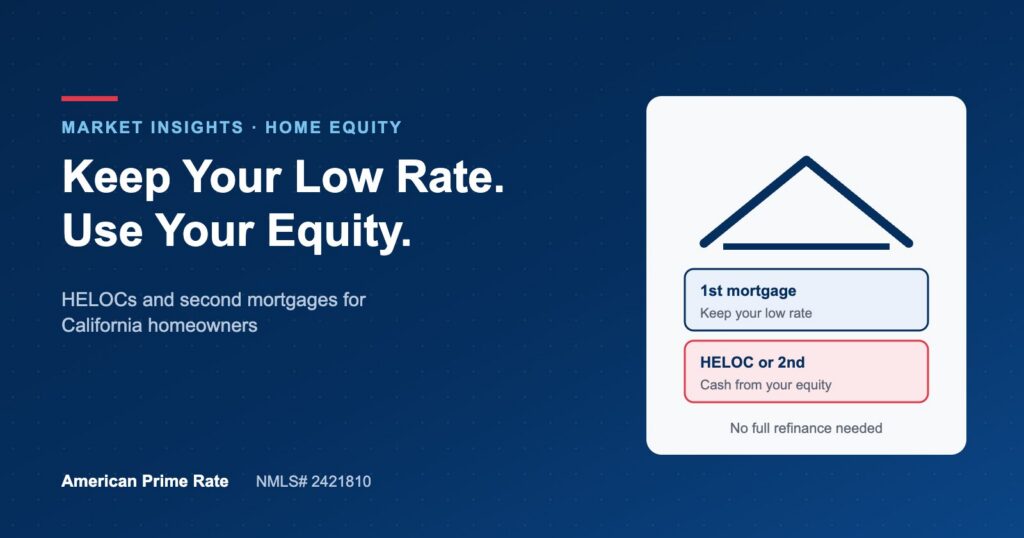
If you locked a 3% or 4% mortgage a few years ago, you’re probably not giving it up. With the average 30-year rate at 7.32% (Freddie Mac, October 22), refinancing your whole loan would raise the rate on every dollar you owe. But you may still need cash for debt, a remodel or a safety net. There’s a way to get it without touching your first mortgage.
The 7% problem for homeowners
Most California homeowners are in an unusual spot: a low rate on the first mortgage and a lot of equity built up on top of it. National home prices are still up about 2% to 2.4% from a year ago, so that equity keeps growing.
The Fed held rates steady on October 28, and most economists don’t expect cuts soon. Waiting for rates to fall before you use your equity could mean waiting a long time.
Cash-out refinance vs. a second loan
A cash-out refinance replaces your whole mortgage with a bigger one at today’s rate. A HELOC or home equity loan leaves your first mortgage alone and adds a separate, smaller loan for just the cash you need. Second loans usually carry a higher rate than first mortgages, so the right choice depends on your balance, your current rate and how much you need. A loan expert can run both side by side for you.
HELOC or home equity loan: which fits?
| HELOC | Home equity loan (2nd mortgage) | |
|---|---|---|
| How you get the money | Draw what you need, when you need it | One lump sum at closing |
| Rate type | Usually variable | Usually fixed |
| Best for | Projects paid over time, an emergency reserve | Paying off debt, a one-time remodel |
What homeowners use it for
- Paying off high-interest debt. Credit card rates are far above mortgage rates, so consolidating can lower what you pay each month.
- Remodeling. Kitchens, ADUs and repairs that add value to the home you plan to keep.
- Cash reserves. A HELOC you don’t draw on can sit ready for emergencies.
- Buying before you sell. If you’re moving, a homeowner bridge or private money loan can free up the equity in your current home for the next down payment. See private money for homeowners.
How much can you borrow?
Lenders look at your combined loan-to-value (CLTV): everything you owe on the home, divided by its value. For example, on a home worth $1,000,000 with $400,000 owed, a lender that allows 85% CLTV would cap total borrowing at $850,000. That leaves up to $450,000 of equity to work with.
American Prime Rate offers programs up to 85% CLTV for qualified borrowers with strong credit. Your exact amount depends on credit, income, the property and the program.
Before you apply
- Pull your latest mortgage statement so you know your balance and rate.
- Get a rough idea of your home’s value from recent sales nearby.
- Decide what the money is for and how much you need. It changes which option fits.
See what your equity can do. Call (866) 569-2877 or explore HELOC options, and a licensed loan expert will compare a HELOC, a second mortgage and a cash-out refinance for your numbers.
Example figures are hypothetical and for illustration only. Market rates cited are published national averages as of the date shown, not an offer of credit. HELOC rates are typically variable and can change. All loans are subject to credit approval, property valuation and program guidelines. American Prime Rate LLC, NMLS# 2421810. Equal Housing Opportunity.