The bond market had a rough week. October’s consumer inflation report came in hotter than expected on Nov. 10, wholesale prices followed on Nov. 13, and by Friday the 10-year Treasury yield was sitting above 5%. CNBC reported the 10-year closed the session at about 5.14% after touching 5.17%.
That matters because the 10-year is the benchmark mortgage rates tend to follow. If you’ve been waiting for a better moment to refinance, here’s what changed, what the weekly averages say, and how to decide whether a refinance still makes sense for you.
What happened to inflation
The Bureau of Labor Statistics said the Consumer Price Index rose 0.4% in October, above the 0.3% economists expected, according to Mortgage Professional America. Core prices, which strip out food and energy, rose 0.3% against a 0.2% forecast. Shelter alone accounted for more than 30% of the monthly gain.
Three days later, the Producer Price Index rose 0.3% for the month and 6.5% over the past year, the largest annual increase since November 2022, per CNBC. Economists watch producer prices because they can show up in consumer prices a few months later.
The result: traders are now pricing a high probability that the Federal Reserve raises its benchmark rate at its Dec. 8–9 meeting. As of Nov. 13, CME FedWatch showed markets treating a December increase as close to certain.
Where mortgage rates stand
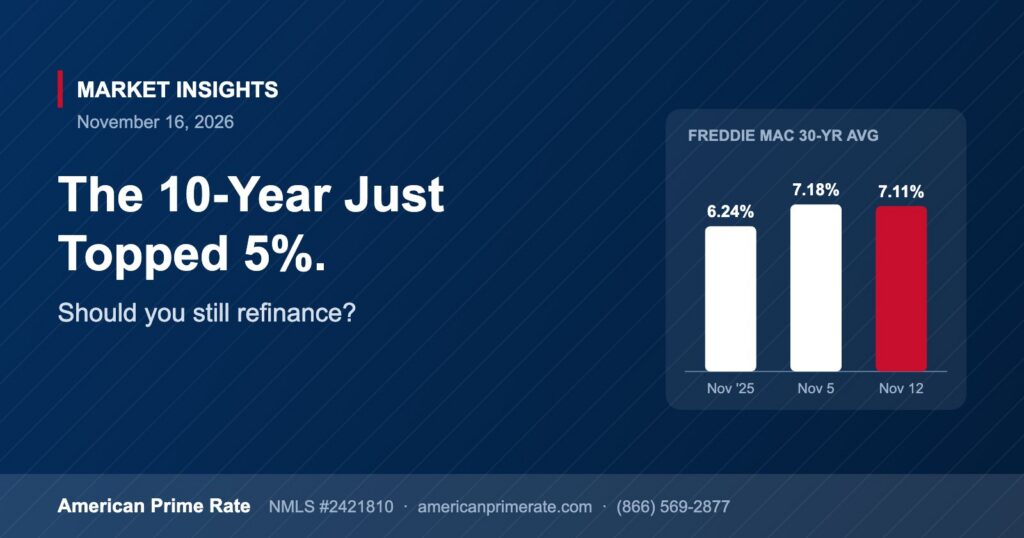
Weekly averages lag the bond market a bit. Freddie Mac’s survey for the week of Nov. 12 showed the 30-year fixed averaging 7.11%, down from 7.18% the week before and the fourth straight weekly decline (Freddie Mac). The 15-year averaged 6.45%. But Freddie Mac’s survey mostly reflects rates locked before the inflation data hit. Daily trackers moved up faster: Real Estate News noted Mortgage News Daily’s index at 7.42% on Nov. 12.
The takeaway: rates are still well above last year’s levels, and this week’s data makes a quick slide back toward 6% less likely in the near term. Averages can change week to week, and your own rate depends on your credit, equity, loan type and other factors.
Who may still benefit from a refinance
A refinance isn’t only about chasing the lowest rate on the board. In a market like this, the people who often benefit are the ones solving a specific problem. A few situations worth a closer look:
| Your situation | Why a refinance may help | What to check |
|---|---|---|
| You bought or refinanced in 2023–2025 at a rate above today’s averages | Possible payment savings if rates dip | Break-even month and total interest |
| Your ARM is nearing its first adjustment | Trade an uncertain reset for a predictable payment | Reset date, caps and index |
| You pay mortgage insurance and your home has gained value | May be able to drop mortgage insurance | Current value and loan-to-value |
| You carry high-interest credit card or personal debt | Cash-out may consolidate it into one payment | Total cost vs. a HELOC; don’t re-run up the cards |
| You need to remove a borrower after a divorce or buyout | Puts the loan in one name | Qualifying on one income |
If none of these describe you and you have a low rate from 2020 or 2021, you probably don’t need to refinance your first mortgage at all. Keeping that rate and looking at a home equity line for cash needs may be the better path.
Do the break-even math before you decide
Every refinance has costs. The basic test is simple: divide your total closing costs by your expected monthly savings. That tells you roughly how many months it takes to come out ahead. If you plan to sell or refinance again before then, the numbers may not work.
Illustrative example only: if a refinance cost $6,000 and lowered your monthly payment by $250, the break-even point would be about 24 months. If you expect to stay in the home five years or more, that could make sense. If you might move next year, it likely wouldn’t. Your actual costs and savings will differ.
Also look at the total interest you’ll pay over the life of the loan, not just the payment. Resetting a 30-year clock on a loan you’ve paid down for six years can lower the payment but raise the total cost.
What to watch next
- Nov. 19 and Nov. 25: Freddie Mac’s next weekly surveys (the Thanksgiving-week release typically comes a day early). They’ll show whether the post-CPI jump in daily rates carries into the weekly average.
- Dec. 4: The November jobs report. October payrolls rose 165,000 with unemployment at 4.1%, per the BLS.
- Dec. 8–9: The Fed’s final meeting of the year.
- Dec. 10: November CPI.
Each of these can move the 10-year, and mortgage rates with it, in either direction.
Get your file ready now
The borrowers who benefit most when rates dip are the ones who can lock quickly. That means having your income documents, a recent mortgage statement, homeowners insurance details and a sense of your home’s value ready to go. A broker can run the break-even math on your actual numbers and watch the market for you.
If you’re wondering whether a refinance makes sense for your situation, explore your refinance options or call American Prime Rate at (866) 569-2877. We’ll give you a straight answer, even if the answer is “not yet.”
Sources
- Mortgage Professional America, “Mortgage rates set to rise as October CPI tops forecasts,” Nov. 10, 2026
- CNBC, “10-year Treasury yield moves to 5.17% as traders weigh producer price report,” Nov. 13, 2026
- Freddie Mac Primary Mortgage Market Survey, Nov. 12, 2026
- Real Estate News, “Existing home sales haven’t been this slow since 2010,” Nov. 12, 2026
- U.S. Bureau of Labor Statistics, Employment Situation, October 2026 (released Nov. 6, 2026)
American Prime Rate LLC · NMLS #2421810. This is not a commitment to lend. All loans are subject to credit approval, appraisal and underwriting. Figures are market averages from the sources above, not rate quotes or offers. Examples are illustrative only.