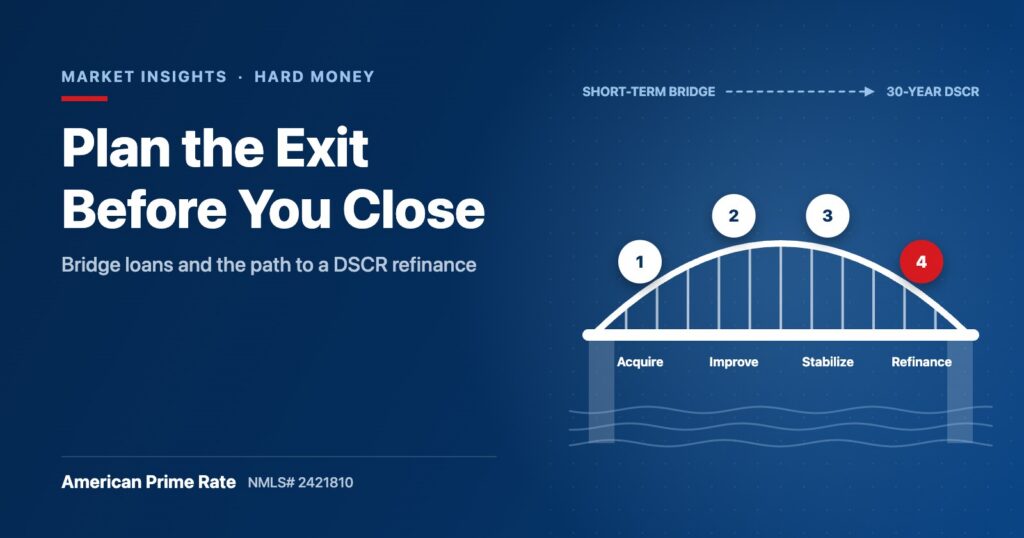
Hard money has always been about speed. When a good property needs to close in days, not weeks, a short-term asset-based loan gets you there. But in this market, the fast part is easy. The hard part is getting out.
What changed this fall
- Long-term rates are higher. Freddie Mac’s 30-year average held at 7.40% last week, up from 6.27% a year ago. The 10-year Treasury hit its highest level since 2002 in early October and is still near 5.1%.
- The Fed isn’t rescuing anyone. It raised rates in September, and markets expect a hold, not a cut, on October 27–28.
- Resale margins are thinner. ATTOM’s typical gross flip margin fell to 21.5% in Q2 2026, down from 27.6% a year earlier, and that’s before rehab, financing and holding costs.
- Homes take longer to sell. National inventory sat at a 4.9-month supply in August, giving buyers more choices and more leverage.
None of that makes hard money a bad tool. It makes the plan around it more important.
What hard money typically costs
Short-term investor loans are priced for speed and flexibility, not for holding. Federal HMDA data on 2025 loans showed a median note rate of about 10%, a median loan-to-value near 70%, and most loans structured as 12-month, interest-only notes with a balloon at the end. Points and fees come on top of that.
That’s fine for six to twelve months. It gets expensive fast if the project runs long.
Write the exit before you close
The most common hard money problem isn’t the rate. It’s a loan that matures before the property is sold or refinanced. Before you sign, decide which exit you’re planning for:
- Refinance into a DSCR loan and hold. This is the exit more investors are choosing right now. Once the work is done and the property is rented, a DSCR loan replaces the short-term note with a 30-year loan qualified on rent, not your tax returns.
- Sell. Price your after-repair value on today’s comps, not last spring’s, and build in extra days on market.
- Both. List it, but underwrite it as a rental so you have a fallback if it doesn’t sell.
The hard money to DSCR path
| Stage | What happens | Checkpoint |
|---|---|---|
| 1. Acquire | Close fast with a short-term bridge loan | Exit plan written and tested before closing |
| 2. Improve | Complete repairs on budget and on schedule | Reserves cover overruns and carrying costs |
| 3. Stabilize | Lease the property at market rent | Rent covers the DSCR payment at today’s rates |
| 4. Refinance | Replace the bridge loan with a 30-year DSCR loan | Appraisal supports the new loan amount |
Test the refinance now, not at month 11
If the DSCR refinance is your plan, run it before you buy:
- Will the rent cover the payment at today’s rates? Use 7%+, not the rate you hope for.
- Will the appraisal support the loan? The permanent loan is sized on appraised value. A light appraisal means bringing cash to close.
- Do you have reserves? Lenders will look at them, and so will you if the project runs over.
The bottom line
Hard money is still one of the best tools for buying fast and adding value. In a 7% market, the investors who win line up the exit before they close. We can structure both ends: the short-term loan to buy, and the DSCR loan to hold.
Have a deal in front of you? Send us the address, purchase price, repair budget and expected rent. We’ll map out the purchase loan and the exit together. Get terms for my deal or call (866) 569-2877. Learn more about hard money and bridge loans.
Market data as of October 19, 2026: Freddie Mac Primary Mortgage Market Survey (Oct 15), U.S. Treasury, Federal Reserve, ATTOM (Q2 2026), HMDA (2025 loans). American Prime Rate LLC, NMLS# 2421810. Business-purpose loans for non-owner-occupied investment properties only. Rates, terms and programs are subject to change without notice. Not a commitment to lend. All loans subject to approval and property eligibility.