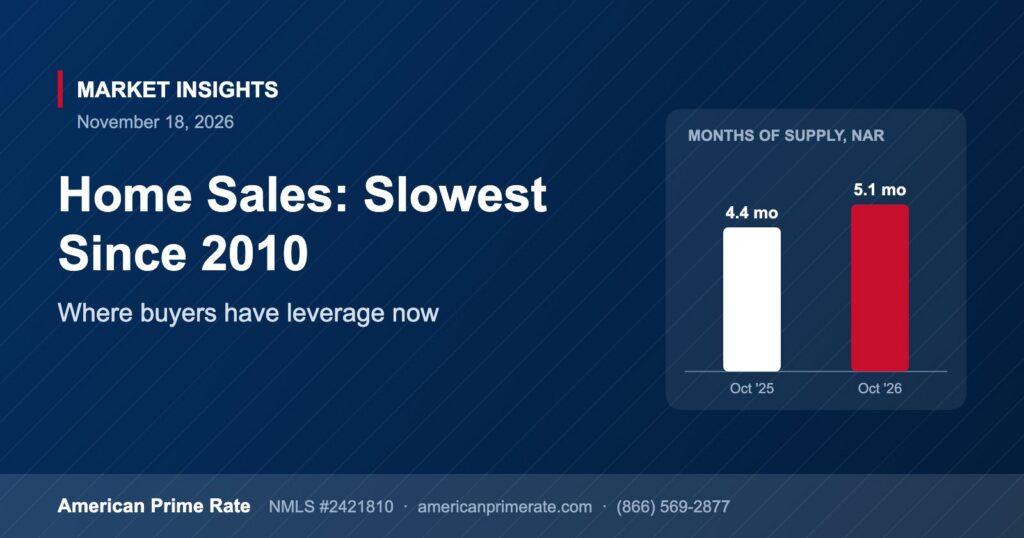
If it feels like nothing is selling, you’re not imagining it. The National Association of Realtors reported on Nov. 12 that existing-home sales fell 5.5% in October to a seasonally adjusted annual pace of 3.75 million, the lowest level since August 2010 (NAR via GlobeNewswire).
For sellers, that’s a tough headline. For buyers who are financially ready, it can mean something rare in California: room to negotiate.
The numbers behind the slowdown
Here’s what NAR’s October report showed nationally and in the West, which includes California:
| October 2026 | National | West region |
|---|---|---|
| Sales (annual pace) | 3.75 million (−8.8% y/y) | 650,000 (−14.5% y/y) |
| Median price | $416,700 (+0.4% y/y) | $624,300 (flat y/y) |
| Unsold inventory | 5.1 months (4.4 a year ago) | — |
| Median days on market | 35 (34 a year ago) | — |
| First-time buyers | 29% of sales (32% a year ago) | — |
Supply is building. At 5.1 months, unsold inventory is at its highest level since November 2015, according to Real Estate News. Homes are also taking longer to sell, with a median of 35 days on market. Sales in the West fell faster than anywhere else in the country, down 14.5% from a year ago.
Prices, on the other hand, have barely moved. The national median rose just 0.4% from a year earlier, and the West’s median was flat. That’s the classic setup for a negotiating market: sellers can’t easily cut their way to a sale without losing equity, but they also can’t count on multiple offers anymore.
California affordability is still the hurdle
California’s affordability picture hasn’t improved much. The California Association of Realtors’ third-quarter index found that only 19% of households could afford a median-priced home of about $894,630, and buyers needed a minimum annual income of $228,000 to cover a monthly payment of roughly $5,700, including taxes and insurance (C.A.R.).
That’s why the leverage matters. When the list price is hard to move, the terms around it often aren’t.
Where buyers have room to negotiate
In a slow market, the purchase price is only one lever. Many buyers find more value in the terms around it:
- Seller credits toward closing costs. A credit can lower the cash you need at closing. Credits are subject to lender and loan-program limits.
- Seller-paid rate buydowns. A seller can sometimes pay to temporarily or permanently lower the buyer’s rate. In a 7% market, that can do more for your monthly payment than a small price cut. Ask how any buydown is structured before you rely on it.
- Repairs or repair credits after an inspection, rather than accepting the home as-is.
- Timing. A flexible closing date or rent-back can matter a lot to a seller who’s buying their next home.
- Keeping your contingencies. In a hot market, buyers waived inspection and appraisal protections to compete. With homes sitting longer, many buyers can keep them.
The right mix depends on the seller’s situation. A home that’s been listed for 60 days is a different conversation than one that hit the market last weekend.
Get your financing lined up first
Negotiating power only works if the seller believes you can close. A full pre-approval, with income and assets reviewed up front, makes your offer stronger than a quick pre-qualification. It also tells you what payment you’re actually comfortable with before you start talking credits and buydowns.
If you’re self-employed, a real estate investor or have income that doesn’t fit a standard W-2 file, get that conversation started early. Programs that use bank statements or other documentation can take a bit more prep.
What could change the picture
Rates are the swing factor. Freddie Mac’s 30-year average was 7.11% on Nov. 12, and markets expect the Fed to raise rates at its Dec. 8–9 meeting. NAR’s chief economist Lawrence Yun said there could be sizable pent-up demand if mortgage rates come down. If that happens, today’s negotiating room could shrink quickly as buyers return. C.A.R.’s 2027 forecast calls for California sales to rise 3.7% next year, with the median price up a modest 1.4% (C.A.R. forecast).
Nobody can time the market perfectly. But buyers who are ready while others wait often get better terms than the ones who arrive with the crowd.
Talk through your purchase plan
Want to see what a seller credit or buydown could mean for your payment? Explore purchase loan options or call American Prime Rate at (866) 569-2877. We’ll help you get pre-approved and build an offer strategy around real numbers.
Sources
- National Association of Realtors, Existing-Home Sales, October 2026 (released Nov. 12, 2026)
- Real Estate News, “Existing home sales haven’t been this slow since 2010,” Nov. 12, 2026
- California Association of Realtors, Q3 2026 Housing Affordability Index, Oct. 30, 2026
- California Association of Realtors, 2027 California Housing Market Forecast, Oct. 7, 2026
- Freddie Mac Primary Mortgage Market Survey, Nov. 12, 2026
American Prime Rate LLC · NMLS #2421810. This is not a commitment to lend. All loans are subject to credit approval, appraisal and underwriting. Figures are market averages from the sources above, not rate quotes or offers. Examples are illustrative only.