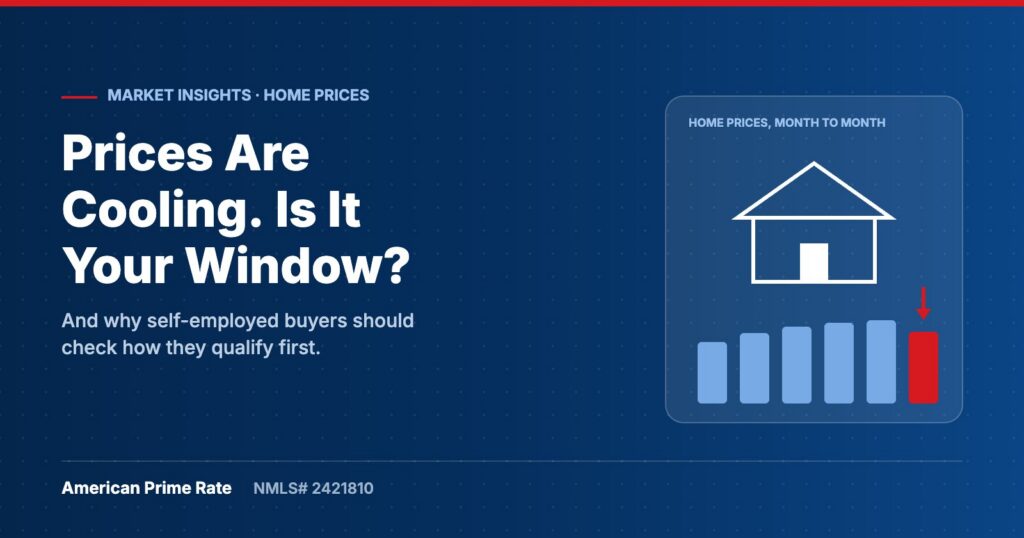
For the first time in a while, buyers have a little room to breathe. National home prices fell 0.3% from August to September, according to Cotality. That’s the largest one-month drop since 2022.
Prices are still up 1.7% from a year ago, and the national median is still above $400,000. But Cotality expects growth to slow to just 0.9% over the next 12 months. Prices aren’t crashing. They’re flattening.
Where it’s cooling fastest
The softening is concentrated in the West and South. Washington, Wyoming, Texas and Hawaii posted year-over-year declines. San Jose, Seattle and Austin are among the fastest-cooling metros.
In California, prices haven’t fallen far enough to fix affordability. Cotality puts the median-priced California home at $754,500, which takes about $180,900 a year in income to afford.
Why this can be a better window
- Rates are off their peak. The 30-year average fell from about 7.4% in early October to 7.18% on Nov. 5 (Freddie Mac).
- Sellers have competition. When prices flatten, homes sit longer, and buyers can often ask for repairs or seller credits.
- Less new supply is coming. Housing starts fell 5.2% in September, the third straight monthly decline. Fewer new homes now can mean tighter inventory later.
A window isn’t a guarantee. Rates could rise again if inflation stays hot, and local markets vary block by block.
The catch for self-employed buyers
That $180,900 is qualifying income, not what’s in your account. For business owners, those can be two very different numbers.
If you own a business, your tax return shows income after write-offs: equipment, rent, mileage, supplies. Good tax planning can make your income look small on paper, even when deposits are strong every month.
| Tax-return path | Bank statement path | |
|---|---|---|
| What’s reviewed | Last 1–2 years of tax returns | 12 or 24 months of business or personal bank statements |
| How income is figured | Net income after write-offs | Average deposits, adjusted per program guidelines |
| Often a fit for | W-2 earners, owners with high reported income | Owners with strong deposits and big write-offs |
That’s where bank statement loans come in. Instead of tax returns, they look at 12 or 24 months of bank statements and calculate income from your average deposits. Other paths use a CPA-prepared profit and loss statement, 1099s, or your assets.
Before you shop, find out which path fits you. Knowing your real buying power is what turns a soft market into an actual opportunity.
Talk it through: Call (866) 569-2877, see how our Non-QM loans work, or contact us.
Price and income figures are from Cotality; rates are Freddie Mac national averages, not American Prime Rate offers. This is general information, not a commitment to lend. All loans subject to credit approval and underwriting; documentation varies by program; not all applicants qualify. American Prime Rate LLC · NMLS# 2421810 · Equal Housing Opportunity.